Integrating the 3D Library Icon 15 Image into Modern Digital Workflows
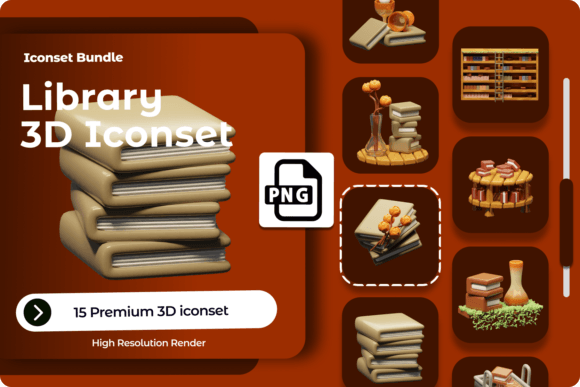
In the current landscape of digital design and content creation, the choice of visual assets often dictates the perceived quality and professionalism of a project. The 3D Library Icon 15 Image represents more than just a graphical element; it is a strategic resource for professionals seeking to convey concepts of education, knowledge, and information storage with depth and realism. When working with high-resolution assets, specifically those rendered at 3000 x 3000 pixels in PNG format, the integration process requires a thoughtful approach to ensure compatibility, efficiency, and visual consistency across various media.
This asset serves as a bridge between abstract concepts like "learning" or "research" and tangible visual communication. Whether you are a marketer designing a landing page for an online course, an educator building a presentation deck, or a developer creating a user interface for a knowledge base, understanding how to effectively deploy this icon is crucial. The following sections outline practical methods for incorporating this high-fidelity graphic into your existing workflows, ensuring it enhances rather than complicates your creative process.
Pre-Production Planning and Asset Verification
Before dropping any asset into a layout, successful execution begins with verification. The 3D Library Icon 15 Image is provided as a high-resolution PNG file, which implies transparency and readiness for immediate use. However, prudent planning involves checking the specific lighting direction and shadow rendering of the 3D object. Since this is a realistic render, it carries specific light source assumptions. If your project utilizes flat design elements with no shadows, placing a heavily shaded 3D icon might create visual dissonance.
To mitigate this, review the icon against your brand's style guide during the preparation phase. Ask yourself if the realistic texture of the books and the depth of the shelf align with your current aesthetic. If your workflow involves a mix of 2D vectors and 3D renders, this icon can serve as a focal point to draw attention to key calls-to-action, such as "Download Syllabus" or "Access Research Data." Ensuring that the resolution matches your output requirements is also vital; while 3000 x 3000 pixels is excellent for print and high-DPI screens, you may need to create downscaled versions for mobile web performance to maintain loading speed without sacrificing clarity on smaller devices.
Seamless Integration Across Different Media Types
The versatility of the 3D Library Icon 15 Image allows it to function effectively at various stages of a project lifecycle. Its application differs significantly depending on whether the end goal is a static document, a dynamic website, or a video presentation.
- Web and UI Design: In web environments, isolated objects work best when they have clear breathing room. Use the PNG transparency to overlay the icon on colored backgrounds or gradient meshes that match your site's theme. Because the file is high resolution, it scales down perfectly for retina displays, ensuring crisp edges on icons representing categories like "Documentation," "E-Library," or "Resources."
- Print and Publication: For brochures, annual reports, or academic posters, the 3000-pixel width provides sufficient density for high-quality printing. Here, the icon can act as a section divider or a visual anchor next to headers regarding literature, history, or scientific archives. The realistic shading adds a tactile feel to paper media, making the content appear more substantial.
- Presentation Decks: Educators and business consultants often rely on visuals to break up text-heavy slides. Placing this icon next to bullet points about "Knowledge Management" or "Corporate Training" helps audiences retain information better. The 3D aspect adds a modern touch that distinguishes the slide from generic clipart-heavy presentations.
When integrating these assets, consistency is key. If you use the library icon on a homepage, consider using stylistically similar 3D assets for other sections to maintain a cohesive visual language. Mixing disparate styles—such as a hyper-realistic 3D book next to a hand-drawn cartoon pencil—can confuse the viewer and dilute the professional impact of the design.
Enhancing User Experience and Conceptual Clarity
Beyond aesthetics, the primary function of an icon is communication. The 3D Library Icon 15 Image instantly signals concepts related to education, study, and information. In a user interface, this reduces cognitive load; users do not need to read a label to understand that a specific button leads to a repository of files or a learning module.
For entrepreneurs and small business owners launching online platforms, leveraging such recognizable symbols can streamline navigation. For instance, in an e-learning app, this icon could represent the main curriculum hub. In a corporate intranet, it might denote the employee handbook or research database. The psychological association between a library and "organized knowledge" makes it a powerful tool for guiding user behavior. By placing this icon strategically, you subtly encourage users to explore content, read documentation, or engage with educational materials.
Furthermore, the realistic nature of the render supports trust. In sectors like finance, law, or academia, where credibility is paramount, cartoonish graphics may feel too informal. A high-quality, realistic 3D render conveys seriousness and attention to detail, reinforcing the authority of the content it accompanies.
Workflow Optimization and File Management
Efficient use of digital assets extends beyond the design phase into file management and long-term maintenance. When downloading high-resolution files like the 3D Library Icon 15 Image, it is advisable to establish a structured folder system immediately. Organize assets by project, date, and type (e.g., "Icons/3D/Education"). This practice saves significant time during future updates or when scaling a project.
Consider creating a master file where the original 3000 x 3000 PNG is stored untouched. From this master, generate derivatives optimized for specific uses: web-optimized PNGs with reduced file size for faster loading, cropped versions for social media avatars, or grayscale variants for monochrome print layouts. This proactive approach ensures that you always have the right format ready, preventing the need to re-download or re-process files later.
Additionally, keep track of licensing and attribution requirements if applicable. While many resources are free to use, maintaining a record of where your assets came from protects you and your clients from potential intellectual property issues down the line. Good organization is a hallmark of professional workflow and contributes to the overall reliability of your deliverables.
Maximizing Impact Through Contextual Pairing
To get the most out of the 3D Library Icon 15 Image, pair it with complementary design elements. Typography plays a massive role here; a clean, sans-serif font often balances the complexity of a 3D render well, allowing the icon to stand out without competition. Color theory is equally important. Since the icon likely features natural wood tones, paper whites, and perhaps leather textures, choose background colors that provide sufficient contrast. Deep blues, soft grays, or warm creams often work well to highlight the details of the books and shelves.
In marketing campaigns, this icon can be part of a broader narrative. For a "Back to School" promotion, it can be animated to float or rotate slightly, drawing the eye in email headers. For a business whitepaper on "Data Literacy," it can sit alongside charts and graphs to humanize the data, suggesting that behind the numbers lies a wealth of study and research.
Ultimately, the value of this asset lies in its ability to adapt. Whether used as a simple decorative element or a functional navigational aid, the 3D Library Icon 15 Image offers a polished, professional look that elevates standard designs. By treating it as an integral part of your planning and execution strategy rather than an afterthought, you ensure that your final outputs are not only visually appealing but also effective in communicating their intended message.
Adopting a disciplined approach to selecting, verifying, and deploying such high-quality graphics will distinguish your work in a crowded digital space. It demonstrates a commitment to quality and a deep understanding of how visual cues influence user perception and engagement. As you continue to build your portfolio or expand your business offerings, keeping a curated library of versatile, high-resolution assets like this one will prove to be an invaluable investment in your creative infrastructure.